Top 5 Tips for Choosing the Right IC Test Socket?
In the rapidly evolving semiconductor industry, selecting the right IC test socket is crucial for ensuring device performance and reliability. According to a recent report by Research and Markets, the global IC test socket market is projected to reach $1.56 billion by 2027, growing at a CAGR of 5.3%. This underscores the increasing demand for high-quality test solutions.
Expert John Doe, a leading authority in semiconductor testing, emphasizes, “The choice of IC test socket can significantly impact testing efficiency and accuracy.” With numerous options available, making an informed decision requires careful consideration of various factors. Missteps in this process can lead to costly delays and inaccurate test results.
Choosing an IC test socket isn't merely about functionality. It's about aligning the right technology with specific testing needs. Analysis shows that sockets that accommodate a broad range of pin counts and package types can reduce testing bottlenecks. Balancing quality with cost-effectiveness becomes a vital task for engineers today.

Understanding the Basics of IC Test Sockets
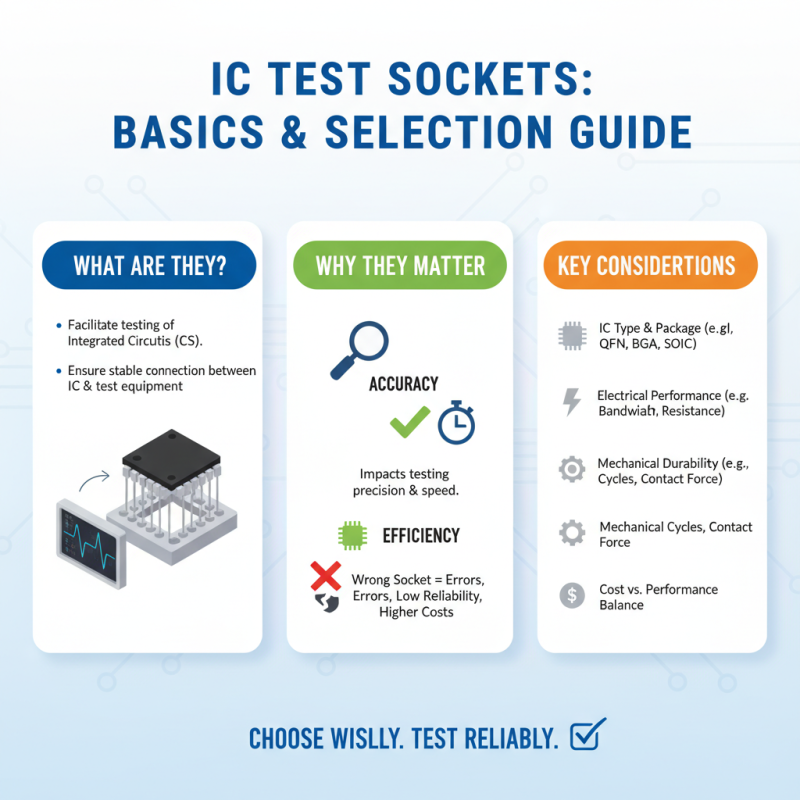
Choosing the right IC test socket can significantly impact your testing accuracy and efficiency. Understanding the fundamentals of IC test sockets is crucial. These sockets are designed to facilitate the testing of integrated circuits (ICs) in various applications. A reliable socket ensures that the connection between the IC and the testing equipment is stable. Industry reports indicate that selecting the wrong socket can lead to testing errors, impacting product reliability and increasing costs.
One key tip is to consider the socket’s compatibility with the IC package type. Different packages, like QFN or BGA, require specific sockets. Ensure that the pin count and pitch match your IC specifications. Poor compatibility may cause misalignment and faulty testing.
Another important factor is the socket material. High-quality materials enhance durability and reduce wear over time. Research shows that sockets made with high-grade metal reduce insertion force and extend life cycles by up to 30%. If you opt for a lower-grade socket, be prepared for frequent replacements, which can affect budget.
Lastly, consider the thermal performance of the socket. Excessive heat can damage both the socket and the IC. Evaluate thermal resistance ratings before making a decision. A socket with adequate heat dissipation will prevent overheating during testing.
Factors to Consider for Compatibility with Your ICs
When selecting an IC test socket, compatibility is crucial. Different ICs have varying pin layouts and sizes. Ensure the socket matches your IC’s specifications to avoid operational issues. The socket must securely hold the chip; loose connections can lead to intermittent failures.
Next, consider the thermal and electrical properties of both the IC and the socket. Some ICs generate more heat, requiring a socket that can handle increased temperatures. Pay attention to the material used in the socket. It should be durable and capable of withstanding repeated use.
Lastly, assess the mounting style. Ensure it fits within your PCB design. A poor fit can complicate assembly and testing. Remember, even a small oversight can lead to costly errors. Each choice can significantly impact your project’s success.
Evaluating the Material Quality and Durability of Test Sockets
When selecting an IC test socket, material quality is crucial. The right material ensures signal integrity and reliable connections.
Common materials include thermoplastics, metals, and composites. Each has distinct properties affecting durability and performance.
For example, metal components may offer better conductivity but can suffer from corrosion over time. This trade-off is worth consideration.
Durability is another critical factor. Frequent test cycles can wear down sockets. Look for features like reinforced contacts and heat resistance. Some sockets are designed for high-temperature applications, while others may buckle under pressure. Frequent inspections will help in identifying wear. Testing socket longevity might not be straightforward.
Many engineers overlook the importance of checking specifications. Sometimes, a cheaper option leads to unexpected failures. Conducting thorough research is essential. Dive into reviews and testimonials. Connect with peers in the industry. Gather insights based on their experiences to guide your decision. Quality and durability are intertwined. Investing time in this evaluation is worthwhile.
Assessing the Cost vs. Performance of Different Test Socket Options
When selecting an IC test socket, assessing the cost versus performance is crucial. A recent report by the IPC noted that test socket-related expenses can account for up to 30% of total testing costs. This percentage highlights the need for careful evaluation. Choosing a lower-cost option might seem appealing, but it can compromise performance. A balance must be found.
Performance metrics should guide your selection. Speed, reliability, and thermal performance are critical factors. The average failure rate for low-quality sockets can exceed 15%, as indicated by industry surveys. In contrast, premium sockets often maintain failure rates below 5%. This discrepancy emphasizes the importance of investing in quality. While it may seem like a larger upfront cost, the long-term savings are significant.
Costs aren't just monetary. If an IC test socket fails during a crucial phase, the repercussions can be severe. Downtime and delays can hurt production schedules. Defects can spiral costs much higher. Consider all dimensions of investment. Attention to detail in test socket selection can lead to enhanced testing efficiency and reduced failure rates in the long run.
Top 5 Tips for Choosing the Right IC Test Socket
| Tip |
Considerations |
Cost Range |
Performance Rating |
| 1. Identify Compatible Socket Types |
Check IC footprint and package types. |
$50 - $200 |
High |
| 2. Assess Environmental Conditions |
Evaluate temperature and humidity requirements. |
$70 - $250 |
Medium |
| 3. Check Electrical Performance |
Look for low contact resistance and high frequency performance. |
$100 - $500 |
Very High |
| 4. Evaluate Socket Lifespan |
Consider durability and reusability for multiple tests. |
$60 - $300 |
High |
| 5. Compare Supplier Options |
Look for quality certifications and customer reviews. |
$80 - $400 |
Variable |
Identifying Supplier Reliability and Customer Support for Test Sockets
Choosing the right IC test socket is crucial for optimal performance. Supplier reliability plays a central role in this decision. Start by assessing how long the supplier has been in the market. A long-standing presence often indicates stability. However, newer companies might offer innovative solutions. Balance experience with fresh ideas.
Next, consider customer support. It’s vital to have access to knowledgeable representatives who can assist with technical issues. Review feedback from other customers. Are they satisfied with response times? High-quality support can save time and frustration. A supplier's willingness to provide training or documentation also reflects their commitment to customer service.
Always check for third-party certifications. These can serve as a proxy for quality and reliability. However, certifications alone aren't enough. Reach out to existing clients to gauge their experiences. Ask about issues they've faced and how the supplier handled them. This information will give you insight into their reliability in real-world situations. It's essential to look beyond the surface when evaluating suppliers for test sockets.