How to Choose the Right Micro Pogo Pins for Your Project?
Choosing the right micro pogo pins for your project can be challenging. These tiny connectors play a critical role in electronics design. As John Smith, a leading expert in connector technology, once stated, "Selecting micro pogo pins requires careful consideration of your specific needs."
Micro pogo pins come in various sizes and specifications. Understanding their applications is crucial. These connectors ensure reliable electrical contact in tight spaces. However, the wrong choice could lead to project failure. Some designers rush the selection process, overlooking essential factors.
It is essential to assess the thickness and quality of the pins. Cheaper options may save costs but often degrade performance. Experienced engineers emphasize the importance of choosing durable materials for longevity. Each project's requirements can vary significantly, making it vital to analyze your needs before finalizing your choice.
Understanding Micro Pogo Pins: Key Features and Specifications
Micro pogo pins are essential components in many electronic projects. Understanding their key features can help you make informed choices. These connectors are compact and designed for high-density applications. Their spring-loaded design ensures reliable electrical contact, which is crucial in devices where space is limited.
One major specification to consider is pin pitch. This refers to the distance between the center of one pin and the next. Common pitches are 1.00 mm and 1.27 mm. Choosing the wrong pitch might lead to connection issues. Make sure to match your board's layout.
Additionally, look into the number of pins required for your application. Are you designing a simple circuit or something more complex? A higher pin count might offer better functionality but could complicate circuit design. Don't overlook the current rating either. This determines how much power each pin can handle safely. Finding the right balance of these specifications will greatly enhance your project's success.
Identifying Project Requirements for Micro Pogo Pin Selection
When selecting micro pogo pins for a project, understanding the specific requirements is crucial. Start by assessing the device’s size and available space.
Micro pogo pins come in different dimensions. Choosing the wrong size can lead to connection issues or physical interference.
Measure carefully. Pay attention to the pitch and the number of pins. A tighter pitch may fit more pins but could complicate manufacturing.
Next, consider the electrical needs. Check the current rating and ensure the pins can handle the necessary voltage. Insufficient ratings can cause performance problems.
Also, think about the insertion and withdrawal cycles. Some applications require frequent connections. Look for durability in materials used.
Physical factors such as temperature, humidity, and even exposure to chemicals can impact performance over time.
Documentation can often seem overwhelming. The data sheets, while detailed, can be confusing. Parts may have similar specifications but vary in quality and longevity.
Be reflective about your choices. A small oversight in understanding these details can lead to project failure. Don’t rush—take the time to evaluate the specific needs of your project.
Each selection decision can lead to better functionality.
Evaluating Compatibility with Circuit Board Design
When selecting micro pogo pins, evaluating compatibility with your circuit board design is crucial. These pins must align with the board's dimensions and layout. According to industry reports, misalignment can lead to poor connectivity. Designs that lack precision may result in faulty signals. Boards with tighter spaces require smaller pin diameters. This could impact overall performance and reliability.
Pay attention to the pitch, the distance between the center of one pin to the next. A typical pitch size is between 0.5mm to 2.0mm, though custom sizes exist. Ensure your design accounts for this to prevent short circuits. Adjusting for tolerances is often overlooked. The pin's height and insertion depth also dictate compatibility.
Tips: Always prototype in small batches. Testing can reveal issues early. Review the board layout multiple times. Small mistakes can lead to big problems. If you're facing unique design challenges, consider simulations. They identify potential problems before production. Placeholder designs can help visualize pin placement. Avoiding compatibility issues from the start saves time and costs later.
How to Choose the Right Micro Pogo Pins for Your Project?
This chart illustrates the compatibility evaluation of various micro pogo pins based on different circuit board designs. The data focuses on how well each type of micro pogo pin aligns with standard specifications, durability, and price efficiency.
Comparing Material Types and Their Impact on Performance
When selecting micro pogo pins, material choice profoundly impacts performance. Common materials include stainless steel, bronze, and gold-plated options. Each has unique properties that affect conductivity, durability, and cost.
Stainless steel pogo pins offer excellent resilience. However, their conductivity may not match that of gold-plated variants. Reports indicate that the use of gold plating can increase conductivity by up to 30%. This factor is crucial when dealing with high-frequency signals. Nevertheless, gold pins can be more expensive, which might not fit all budgets.
Tip: Evaluate the project's specific electrical needs. If high performance is essential, consider investing in gold-plated pins. If the application is less demanding, stainless steel may suffice.
Bronze pins bridge the gap between cost and performance. They provide good conductivity at a lower price point. However, their susceptibility to corrosion can be a concern. Industry data suggests that bronze pins may lose conductivity faster than their stainless steel counterparts under certain conditions.
Tip: Assess the environment where the pins will be used. If humidity and corrosion are potential issues, a more durable option is advisable.
Assessing Cost and Supplier Options for Micro Pogo Pins
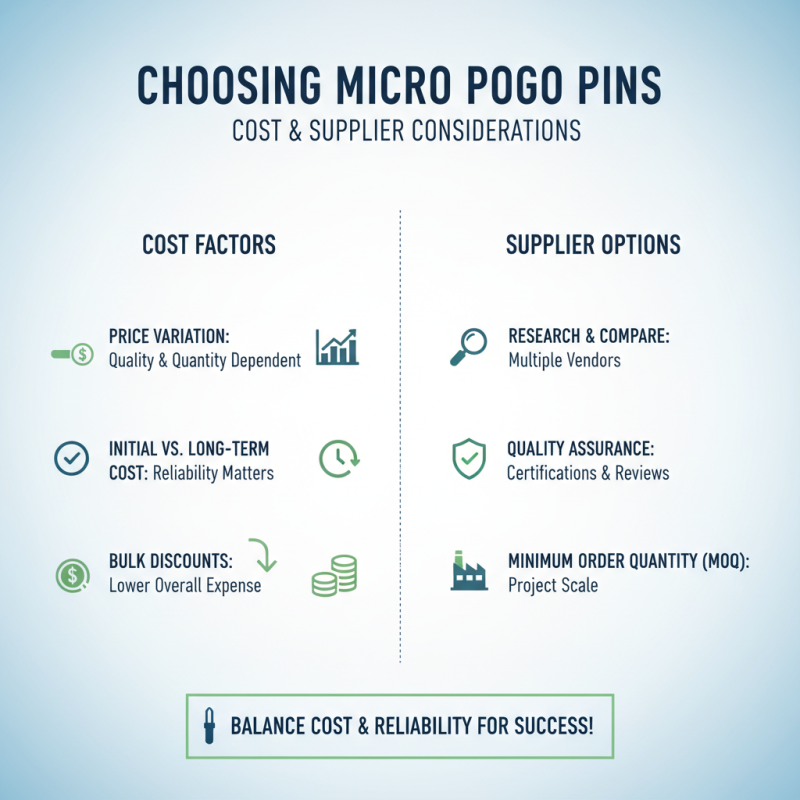
When choosing micro pogo pins for your project, cost and supplier options are critical. Prices vary widely based on quality and quantity. Sometimes, cheaper options seem attractive, but they might not meet your needs. It is important to balance cost with reliability. Some suppliers offer bulk purchasing discounts. This can help lower overall expenses. Always calculate the long-term cost, not just the initial price.
Supplier reputation matters significantly as well. Research each supplier's background. Look for reviews and testimonials. Find out whether they offer warranties or guarantees. Some suppliers may have stock issues and lengthy delivery times. This can impact your project timeline. You might save money upfront but face delays later.
Consider the quality of materials and manufacturing processes as well. Low-quality pins may fail prematurely. It's good to ask about the production standards. If a supplier cannot provide clear information, it may be a red flag. Weighing these factors carefully is essential. Remember, the cheapest option isn't always the best choice for your project.