Top Stair Climbing Robots for Efficient Material Handling?
In today's fast-paced world, efficient material handling is crucial for various industries. Stair-climbing robots play a significant role in optimizing logistics and improving productivity. These advanced machines are designed to navigate stairs with ease, ensuring that heavy items are transported safely and swiftly. Among their remarkable features is the innovative "Stair-Climbing Robots Tracks," which enhances their ability to tackle steep gradients.
The growing demand for reliable delivery systems has fueled interest in these robots. Their unique design allows them to move seamlessly across uneven surfaces and stairs. This technology minimizes human labor while maximizing efficiency. Many businesses are exploring the use of stair-climbing robots. However, adopting this technology requires a careful understanding of its limitations and potential challenges.
As industries embrace automation, stair-climbing robots stand out for their versatility. Yet, questions remain about their durability and adaptability in diverse environments. Evaluating these robots requires a keen eye and thorough research. Despite their promise, the journey toward complete reliability and performance continues.
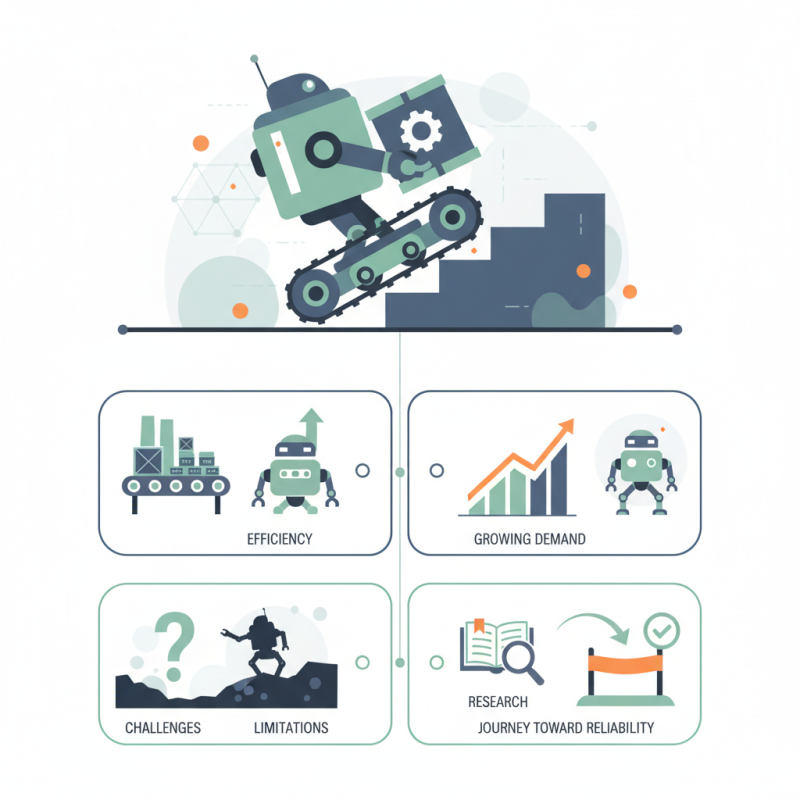
Overview of Stair Climbing Robots and Their Applications in Material Handling
Stair climbing robots have emerged as a vital solution in material handling. These robots can transport heavy loads up and down stairs, reducing the risk of injury for human workers. Their ability to navigate uneven surfaces makes them suitable for various environments, from warehouses to construction sites. Equipped with advanced sensors, they can detect obstacles and adjust their path accordingly. This adaptability enhances their reliability in challenging situations.
In many instances, the implementation of stair climbing robots has not been flawless. Their effectiveness might diminish on steep stairs or when overloaded. Users often report the need for continuous monitoring to ensure safety and efficiency. Additionally, training staff to operate and maintain these robots remains a challenge. Despite these issues, the benefits of improved efficiency and reduced manual labor are significant. As technology advances, addressing current shortcomings will be crucial to fully realize the potential of these innovative machines in material handling.
Key Features of Effective Stair Climbing Robots for Various Industries
Stair climbing robots are revolutionizing material handling in various industries. They can navigate stairs, curbs, and other obstacles with ease. This ability allows for efficient transportation of goods, especially in warehouses and construction sites. These robots are designed to carry heavy loads while maintaining stability. The balance and grip on uneven surfaces are crucial features. They help reduce injuries related to manual lifting.
Reliable battery life is another key attribute. A longer battery duration means fewer interruptions during work. Sensors for obstacle detection enhance safety. They prevent collisions and ensure smooth navigation. Integration with existing systems is essential for enhancing productivity.
One area for improvement is user interface design. Complex controls can hinder efficiency. Companies should prioritize intuitive designs. Maintaining and repairing these robots can be challenging. Clear guidelines are necessary for troubleshooting. Regular updates to the software can improve functionality. The evolving technology will shape future enhancements in this field.
Comparison of Leading Stair Climbing Robots on the Market Today
The market for stair climbing robots is evolving rapidly. Research shows that these robots can increase efficiency in material handling by up to 30%. With a growing demand for automation, businesses are exploring various options to enhance delivery capabilities. Some robots are designed specifically for heavy loads. Others focus on versatility and speed, adapting to different stair types.
Current models integrate advanced sensors and AI technology. They can navigate obstacles and adjust to their environment automatically. Interesting reports suggest that robots equipped with machine learning can reduce human error in logistics by nearly 25%. However, reliability concerns remain, especially in unpredictable settings. Some robots struggle on uneven stairs, highlighting the need for improvement.
User feedback points to usability issues as well. Some models require extensive training before operators feel comfortable. Manufacturers still face challenges in developing user-friendly interfaces. While the technology shows promise, the journey to perfecting stair climbing robots continues. The balance between innovation and practical use remains a topic for ongoing discussion.
Innovations and Future Trends in Stair Climbing Robot Technology
Stair climbing robots are evolving rapidly. They are becoming crucial in material handling. These machines can navigate stairs, curbs, and uneven surfaces. Their designs incorporate advanced sensors and AI. This technology makes them safer and more efficient in various environments.
Recent innovations focus on energy efficiency and load capacity. Many robots now use lightweight materials. This reduces power consumption while increasing their payload capacity. The integration of machine learning allows these robots to adapt to new terrains. They continually learn from their surroundings, improving over time.
Despite these advancements, challenges remain. Not all robots can handle every type of staircase. Some designs struggle with steep or narrow steps. The need for regular maintenance increases as complexity rises. Manufacturers must address these issues to enhance reliability. The future of stair climbing robots promises exciting developments. But it also requires careful consideration of these hurdles.
Challenges and Solutions in Using Stair Climbing Robots for Material Transport
Stair climbing robots are revolutionizing material handling, yet their use presents unique challenges. One major issue is balance. Navigating stairs requires precise weight distribution. If the load is uneven, the robot risks tipping over. This can lead to accidents and equipment failure. Operators must ensure loads are secured and balanced to mitigate risks.
Another challenge is adaptability to different stair types. Some stairs are steep, while others are narrow or uneven. Not all robots can handle these variations effectively. Proper training and regular maintenance are essential for robots to function optimally. Furthermore, operators need to understand the robot's limitations. This knowledge is crucial to prolonging the life of the equipment.
Cost is also a concern. High-quality stair climbing robots can be expensive. Companies must weigh the cost against potential labor savings. It’s a fine balance. Investing in training can yield better long-term results. Operators must also be aware of the need for monitoring and upkeep. Without regular check-ups, even the best technology can fall short of expectations.
Top Stair Climbing Robots for Efficient Material Handling
| Robot Model | Max Load Capacity (kg) | Battery Life (hours) | Weight (kg) | Mobility Features |
| Model A | 100 | 5 | 50 | Obstacle Avoidance, Remote Control |
| Model B | 150 | 6 | 60 | AI Navigation, Terrain Adaptation |
| Model C | 200 | 4 | 70 | Automatic Stair Climbing, Smart Sensors |
| Model D | 120 | 7 | 55 | Foldable Design, Easy Transport |