
Choosing a Plastic Extruder is a practical decision, not just a comparison of machine prices. The right manufacturer can affect product consistency, output, energy use, and maintenance time. China has suppliers serving diverse needs, from compact laboratory lines to large systems for pipes, sheets, profiles, and recycled materials. Their capabilities vary. Details matter.
This guide introduces ten Chinese manufacturers and explains what buyers may want to examine before requesting a quotation. Key considerations include product range, screw and barrel options, automation, customization, documented quality procedures, spare-parts availability, and after-sales support. A polished product page is useful, but it cannot show how a machine performs in your factory. Ask for relevant specifications, installation requirements, and references for similar applications. That is not enough. Confirm which services are included and which require additional fees.
The companies are presented as a starting point for further research, not as a universal ranking. A supplier suited to high-volume pipe production may not fit a small profile line. Public information can also change, so confirm current models, certifications, lead times, and service arrangements directly with each manufacturer. No list is final. Even a careful comparison leaves questions unanswered until materials, tooling, and production targets are discussed. Use the overview to build a shortlist, then verify the details against your actual operating conditions.
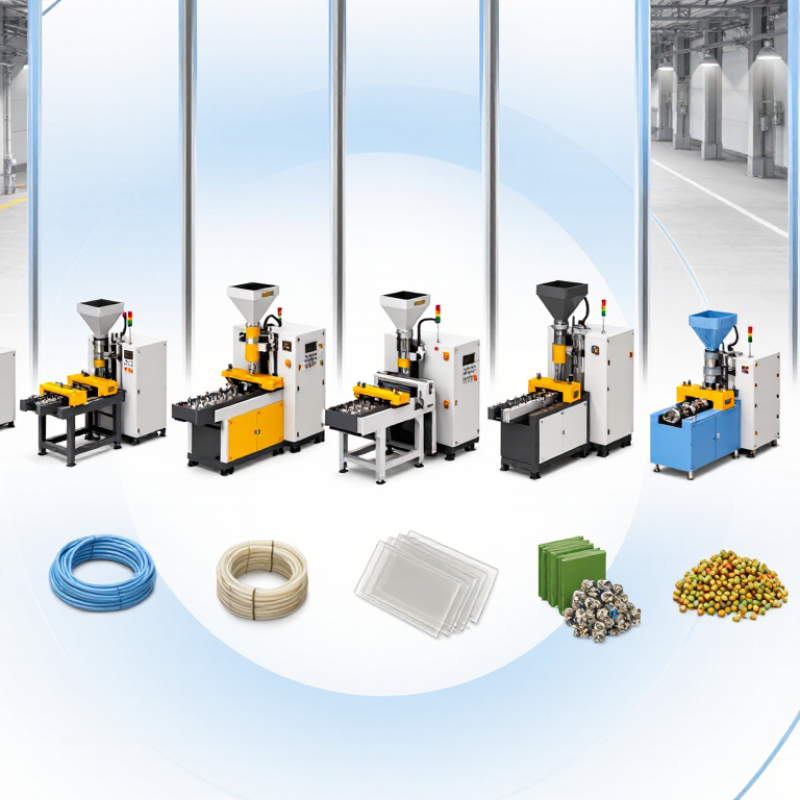
Plastic extruders convert thermoplastic pellets into continuous shapes used in everyday manufacturing. Pellets enter a heated barrel, where a rotating screw moves, compresses, and melts them. Temperature zones and screw speed help maintain a consistent melt, though settings vary with material and product design.
At the die, molten plastic takes the shape of a pipe, sheet, film, or custom profile. Downstream equipment cools and stabilizes the product, then pulls, cuts, or winds it. Manufacturers use these lines for packaging, building components, appliance parts, and protective tubing. The process can run continuously, which supports high-volume production and reduces repeated handling. In practice, output is not always perfectly steady. Small changes in moisture, temperature, or feed rate can affect dimensions and surface finish. Operators should check samples during production, not just at startup.
Tips: Confirm the material’s drying needs before feeding it. Watch melt temperature, line speed, and product dimensions together; adjusting only one setting may create new defects. Record changes, even when the result seems minor.
When assessing Chinese plastic extruder manufacturers, look beyond catalog capacity and advertised output. A dependable supplier can explain screw and barrel choices for your resin, target profile, and production speed. Ask for a trial run using similar material. Check whether output stays steady and the finished product keeps a consistent size. Inspect the control cabinet, heating zones, and gearbox for clear labeling and practical access. Small details matter.
A leading manufacturer should provide measurable quality checks, operating manuals, and realistic delivery and commissioning plans. Request test data, but ask how and where it was collected. Compare energy use at a specified output, not just motor ratings. Check whether spare parts are available and technical support can respond in your operating hours. A factory visit can reveal more than a polished brochure. Still, one visit is only a snapshot.
Tips: Ask for a written specification before comparing quotes. Numbers matter. Verify claimed output with a material trial, and record the test conditions. No scorecard is perfect; I would give more weight to repeatable results than confident sales language.
Who are the top 10 plastic extruder manufacturers in China? There is no dependable, universal ranking. A useful shortlist should include suppliers with proven experience in single-screw and twin-screw systems, plus lines for pipe, profiles, sheets, or film. Some focus on standard production; others build equipment around a customer’s resin and output needs. A tidy ranking can still mislead. A polished catalogue does not prove stable output on a real factory floor.
Tips: Ask for a recent test run using material similar to yours. Check output consistency, screw and barrel specifications, temperature control, and maintenance access. Request references for comparable production lines. Small details matter.
To identify ten strong candidates, compare measurable evidence rather than broad claims: years making the relevant machine type, documented installation history, service response, and clear technical drawings. Ask how the supplier handles a blocked die or a worn screw; practical answers reveal more than sales language. If possible, inspect a running line and watch the melt flow, control-panel readings, and finished product. China has multiple manufacturing hubs, but location alone is not proof of quality. I would keep the shortlist flexible; even a capable factory may not suit every material, budget, or production target.
China’s plastic extruder manufacturers supply equipment for pipes, profiles, sheets, films, and pelletizing. These lines serve construction, packaging, agriculture, automotive, and household-goods producers. The scale is substantial: PlasticsEurope’s Plastics – the Fast Facts 2024 reports 413.8 million tonnes of global plastics production in 2023. Extrusion turns resin into practical forms, from irrigation tubing to protective film.
Product choice depends on the job. Pipe and profile lines make water pipes, window frames, and cable ducts; sheet lines supply thermoforming and packaging converters. Film equipment produces agricultural covers and flexible packaging, while compounding and pelletizing systems prepare consistent material blends. The OECD’s Global Plastics Outlook (2022) estimates that packaging accounts for about 40% of global plastic waste, highlighting the need for reliable film-processing capacity and better control of scrap. Small details matter: screw design, temperature stability, output rate, and material compatibility can affect product quality. Specifications still need careful checking. A fast line is not automatically a good fit. For buyers, real production trials are useful, though sometimes overlooked.
The table below summarizes ten common extrusion-equipment specialties found in China’s plastics machinery sector. Profiles are presented by capability rather than by company name and are not a ranked or independently verified list of individual manufacturers.
| No. | Manufacturer Capability Profile | Typical Equipment or Products | Common Materials | Industries Served | Typical Application |
|---|---|---|---|---|---|
| 1 | Pipe extrusion systems | Single- or multi-layer pipe lines, sizing and cooling units, haul-off equipment, and cutters | PE, PP, PVC, and selected engineering thermoplastics | Water supply, drainage, gas distribution, agriculture, and construction | Manufacturing plastic pipes for fluid conveyance, irrigation, and building infrastructure |
| 2 | PVC profile extrusion systems | Profile extruders, calibration tables, vacuum tanks, haul-offs, and saws | Rigid and modified PVC compounds | Building products, doors and windows, interior fit-out, and electrical installation | Producing window profiles, cable trunking, skirting, and other shaped building components |
| 3 | Sheet and board extrusion systems | Flat-die sheet lines, roll stacks, cooling units, trimming equipment, and winding or stacking systems | PP, PE, PVC, PET, PS, and selected bio-based or recycled blends | Packaging, automotive, appliances, construction, and advertising | Making packaging sheet, thermoforming sheet, protective panels, and rigid boards |
| 4 | Cast film extrusion systems | Flat-die film lines with chill rolls, edge trimming, thickness control, and winders | PP, PE, and multilayer polyolefin structures | Flexible packaging, medical packaging, labels, and industrial films | Producing uniform film rolls for converting, lamination, or packaging operations |
| 5 | Blown film extrusion systems | Single- or multilayer blown-film lines with air rings, bubble control, and winding units | LDPE, LLDPE, HDPE, and compatible barrier-layer polymers | Packaging, agriculture, retail, and industrial wrapping | Making flexible film for bags, liners, greenhouse covers, and protective packaging |
| 6 | Twin-screw compounding systems | Co-rotating twin-screw extruders, feeders, side feeders, venting, and pelletizing systems | PP, PE, ABS, PA, PC, and polymer blends with additives or fillers | Plastics compounding, automotive, electrical and electronics, and consumer goods | Dispersing pigments, fillers, fibers, impact modifiers, or other additives into polymer compounds |
| 7 | Plastic recycling and pelletizing systems | Recycling extruders, melt filtration, degassing, strand or underwater pelletizing, and feeding units | Processed PE, PP, and selected other thermoplastic regrind or flakes | Plastic recycling, packaging, consumer products, and materials recovery | Converting suitable recycled plastic feedstock into pellets for further processing |
| 8 | Cable and wire coating lines | Insulation and sheathing extruders, crossheads, cooling troughs, capstans, and take-up units | PVC, PE, PP, and selected cable-grade compounds | Power transmission, telecommunications, appliance wiring, and automotive components | Applying insulation or protective outer sheaths to wire and cable conductors |
| 9 | Foam extrusion systems | Sheet or profile foam lines with metering, cooling, calibration, and cutting equipment | PS, PE, PVC, and other process-compatible thermoplastics | Packaging, construction, insulation, sporting goods, and transportation | Manufacturing lightweight foam sheet, boards, and profiles for cushioning or insulation |
| 10 | Filament and monofilament extrusion systems | Filament extruders with drawing, heating, winding, and, where required, texturing equipment | PP, PE, PET, PA, and other fiber-forming thermoplastics | Textiles, ropes and netting, brushes, filtration, and technical fabrics | Producing synthetic filaments, monofilaments, and related fiber products |
Comparing Chinese plastic extruder manufacturers starts with your production target, not a brochure headline. Define the resin type, required hourly output, product dimensions, and operating schedule. Then compare screw and barrel materials, drive power, temperature zones, and control accuracy against the same specification. Ask for a machine trial using material similar to yours. Record output, melt stability, scrap rate, and energy use. Numbers matter. A quoted capacity without test conditions is hard to verify.
Check how the supplier handles commissioning, operator training, spare parts, and remote troubleshooting. Request a written list of standard components and recommended wear parts, including lead times and prices. Review inspection records and ask to speak with a recent buyer, if available. A factory visit can reveal assembly quality, wiring labels, and whether test equipment is used. Photos help, but they do not show everything. One successful sample run cannot predict every shift or resin batch.
Tips: Send identical questions to each shortlisted supplier and use a comparison sheet. Clarify warranty exclusions, acceptance criteria, delivery scope, and payment milestones in writing. Also confirm whether the stated output includes trimming or downstream handling. Small details change the real cost.