China Top 10 Date Bar Extrusion Line Manufacturers?
Dates are moving beyond traditional whole-fruit sales into snack bars, filled products, and convenient nutrition formats. FAOSTAT’s Crops and Livestock Products database records global date production at roughly 9.7 million tonnes in 2022. That scale creates real opportunities for processors. It also raises practical demands: sticky date paste can cling to rollers, while seeds, fibers, and moisture differences affect a bar’s texture and shape.
A reliable Date Bar Extrusion Line must handle those details, not just advertise high output. Buyers should compare mixing consistency, extrusion pressure, cutting accuracy, changeover time, cleaning access, and the equipment’s fit with downstream cooling and packaging. Ask for product trials using your own date varieties and recipes. Small differences matter. A line that forms a neat bar with one paste may struggle with a softer blend. This guide examines ten Chinese manufacturers through practical factors such as engineering experience, customization, documented specifications, and after-sales support. Manufacturer rankings can be imperfect; public information rarely reveals performance across every recipe or factory shift. So treat the list as a starting point, then verify capacity, food-contact materials, and service commitments directly. Those checks make a more useful shortlist than catalog photos alone.
What Is a Date Bar Extrusion Line?
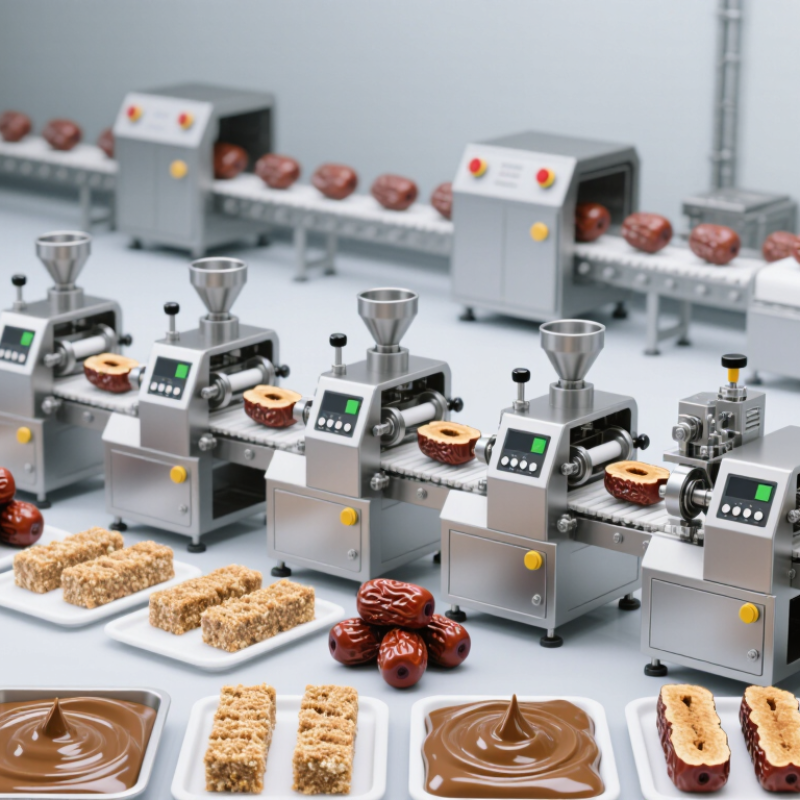
A date bar extrusion line is a connected food-processing system that turns prepared date paste into bars with a controlled shape and weight. A typical line includes a feed hopper, a screw or ram extruder, a forming die, a cutter, and a cooling conveyor. The paste is pushed through the die as a continuous sheet or rope, then cut into pieces. Simple in principle. Not always in practice.
FAOSTAT’s 2022 Crops and Livestock Products dataset records global date production at about 9.7 million tonnes. That scale helps explain why processors need repeatable forming and portioning. However, date varieties differ in moisture and fiber, which can change how paste moves through a machine. Operators may need to adjust feed rate, screw speed, and die temperature. A clean cut starts with a consistent mix.
A practical line also needs food-contact surfaces that are easy to clean, guards around moving parts, and accessible inspection points. Codex Alimentarius’ CXS 143-1985 standard describes quality requirements for dates, highlighting why incoming fruit condition matters before extrusion begins. The standard does not specify a universal machine setting. That gap is worth noting: recipes and equipment behave differently, so trial runs and recorded checks remain important. A few sticky bars can reveal more than a polished brochure.
Date Bar Extrusion Lines: Key Ingredient Profile
Understanding date composition helps explain why date paste is commonly used as a naturally sweet, fiber-containing base in date bars.
Values are grams per 100 g of Deglet Noor dates. Sugars and dietary fiber are included within total carbohydrate, so these values should not be added together. Source: USDA FoodData Central.
How a Date Bar Extrusion Line Works
China Top 10 Date Bar Extrusion Line Manufacturers?
How a Date Bar Extrusion Line Works
A date bar extrusion line turns a mixed filling into bars with a consistent shape. The process begins with prepared date paste, often blended with nuts, seeds, or other ingredients. A feeder moves the mixture into the extruder at a controlled rate. Inside, a screw or roller system pushes it through a shaped die, forming a continuous strip. The strip then travels along a conveyor, where cutting blades divide it into individual bars. Depending on the recipe and equipment, cooling or coating may follow. Small changes in moisture and temperature can affect how cleanly the bars form.
Good setup depends on the mixture, not just the machine. If the paste is too dry, it may crack at the die; if it is too soft, bars can lose their edges. Operators often check the strip width, surface, and cut length during a run. A short test with the actual recipe can reveal issues that a product brochure cannot. Real production is not always perfectly smooth, and that deserves attention.
Tips: Keep the feed steady, clean the die between recipe changes, and record temperature and cutting settings. Check several bars, not just the first one. A small adjustment can make a visible difference.
Key Equipment and Production Stages
China Top 10 Date Bar Extrusion Line Manufacturers?
Key Equipment and Production Stages
A date-bar line starts with sorting, washing, and destoning. Operators then mill the fruit into paste and blend it with grains, nuts, or other ingredients.
FAOSTAT records global date production at approximately 9.7 million tonnes in 2022. That figure signals a substantial raw-material supply, but it does not determine the right line capacity.
Incoming dates vary in moisture, fibre, and stickiness. Check these properties before selecting a feeder, mixer, or screw extruder. Small differences matter.
The mixer must distribute inclusions evenly without turning them into dust. A controlled feed system then delivers the paste to the extrusion barrel and die.
Monitor product temperature, screw speed, and die pressure during trials; these settings affect shape and texture. The formed sheet or rope passes through a cooling section before cutting and wrapping.
Keep transfer belts short where possible. Sticky paste builds up fast.
A clean equipment diagram is not the whole story: washdown access and changeover time can complicate production, and they are easy to underestimate. Test the full recipe on a pilot line before committing to a commercial layout.
Criteria for Evaluating Chinese Extrusion Line Manufacturers
Choosing among China’s date-bar extrusion line manufacturers requires more than comparing quoted hourly capacity. FAOSTAT’s 2022 crop data place global date production at roughly 9.7 million tonnes. That signals a large raw-material base, not a purchasing forecast. Brochures are easy. Ask for a factory acceptance test using your own date paste, including its moisture level and fiber content.
Compare measured output, not headline figures. Require records for kilograms per hour, bar-weight variation, start-up waste, and energy use per kilogram. Check whether operators can adjust the cutter and forming die without lengthy stoppages. A line that handles smooth paste may struggle with coarse pieces. I would want that limitation tested, not explained away.
Hygienic construction deserves close inspection. Look for accessible product-contact surfaces, documented cleaning procedures, and material certificates. Review electrical safeguards, spare-part lead times, and remote support response times. Ask for a written acceptance protocol with measurable pass criteria. Confirm that test data identify the product recipe and operating conditions; otherwise, figures are hard to compare. One weakness remains: sample trials cannot reproduce every shift or seasonal ingredient change. A realistic service plan should account for both.
Profiles of Ten Chinese Date Bar Extrusion Line Manufacturers
China’s date bar extrusion-line market includes manufacturers with different engineering strengths. A useful profile compares more than advertised output. One manufacturer may focus on compact lines for small factories, while another builds continuous systems for larger production floors. A third may offer flexible forming dies for bars with different widths and shapes. Details matter.
Some manufacturers emphasize dough handling and steady feeding. Others specialize in cutting units that produce clean edges with minimal sticking. A fifth profile may focus on adjustable cooling and conveying sections. A sixth may integrate weighing and packaging equipment, while a seventh offers modular layouts for limited floor space. These capabilities should be checked against product samples, not assumed from a brochure. Ask about recipe trials, changeover time, and cleaning access.
The remaining profiles may differ in control systems, customization, installation support, and spare-parts planning. One supplier might provide clear operating documents; another may rely more heavily on remote guidance. A tenth may suit buyers needing a tailored line, though customization can extend delivery and commissioning. Request a process flow, equipment list, and acceptance criteria before comparing quotations. If possible, inspect a running line and observe feeding, extrusion, cutting, and cleanup. Even a polished sample has limits. Real production conditions reveal more.