
Top Dual Torch Pipeline Welding Machines for Global Buyers

Pipeline construction is becoming more automated, but equipment selection still demands practical judgment. A Dual Torch Pipeline Welding Machine can improve deposition consistency, reduce idle movement, and support faster joint production. However, speed alone does not prove value. That assumption needs checking.

The International Federation of Robotics reported 541,302 industrial robots installed worldwide in 2023, showing continued investment in manufacturing automation. This trend also influences pipeline welding, where repeatable travel speed, torch alignment, and controlled heat input matter greatly. The American Welding Society emphasizes qualified procedures, trained operators, inspection, and process control throughout welding operations. ISO 3834 similarly highlights quality requirements for fusion welding and documented production systems. These references provide a useful foundation for global buyers comparing automated welding platforms.

A strong machine should match pipe diameter ranges, wall thickness, welding process, power supply, and site conditions. Buyers should examine torch synchronization, seam tracking, cooling performance, wire feeding, and emergency controls. Field experience suggests that accessible maintenance points often matter more than attractive specifications. Small details matter.

Independent testing, traceable components, and responsive technical support can reduce costly downtime. Yet published performance figures may reflect controlled factory conditions, not dusty yards or remote projects. Buyers should request weld samples, procedure records, and realistic production demonstrations before purchasing. No machine is perfect. The best choice balances productivity, weld quality, operator usability, lifecycle cost, and regional service capability. This guide compares leading options for global pipeline contractors seeking dependable performance rather than impressive claims alone.
Top Dual Torch Pipeline Welding Machines for Global Buyers

What Dual Torch Pipeline Welding Machines Are

Top Dual Torch Pipeline Welding Machines for Global Buyers

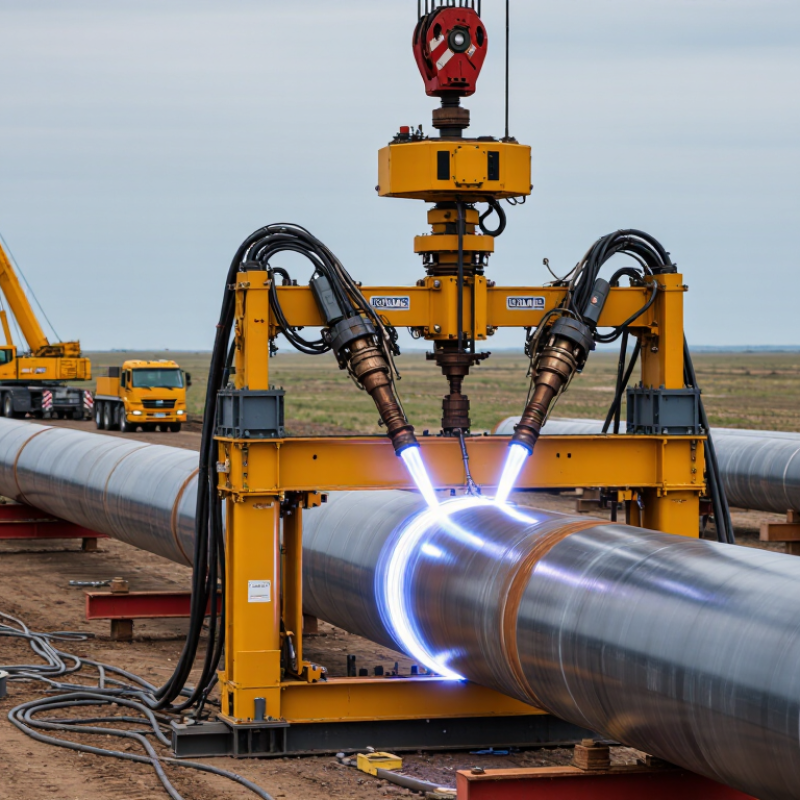
Dual torch pipeline welding machines use two coordinated welding torches during one joint operation. Depending on the configuration, both torches may work on the same weld path or manage separate passes. The system usually combines synchronized wire feeders, arc controls, travel mechanisms, and seam tracking. This coordination can improve deposition rates and reduce repeated setup work. However, dual torches do not guarantee better welds. Poor alignment, unstable shielding gas, or incorrect heat input can create defects quickly.

The International Energy Agency’s Gas 2024 report projects global gas demand to reach more than 4.3 trillion cubic metres by 2029. That continuing infrastructure activity increases pressure for consistent, traceable pipeline fabrication. Meanwhile, the U.S. Bureau of Labor Statistics projects a 2% decline in welding employment from 2023 to 2033. Automation may help address labor shortages, but skilled supervision remains essential. Operators must verify travel speed, interpass temperature, wire compatibility, and torch spacing against approved welding procedures. Small differences matter.

Tips: Ask suppliers for recorded weld data, not only speed claims. Request samples using your pipe diameter, wall thickness, and material grade. Check whether the machine supports procedure qualification under applicable standards, such as API 1104 or ISO 15614. A practical site trial is wiser than a polished brochure. Some machines look efficient on straight sections but struggle near fittings, repairs, or uneven fit-up. That limitation deserves honest review.

How Dual Torch Systems Improve Pipeline Welding Efficiency

Top Dual Torch Pipeline Welding Machines for Global Buyers

Dual torch systems improve pipeline welding efficiency by allowing two controlled arcs to work simultaneously. One torch may weld the internal seam while the other follows the external joint. This can reduce idle time, stabilize heat input, and shorten the welding cycle. It is not magic. Joint design, wall thickness, and operator coordination still determine results.

The American Welding Society’s 2023 Welding Workforce Data report projects a shortage of 330,000 welders in North America by 2028. That pressure makes productive equipment increasingly valuable. A dual torch machine can help one qualified operator manage more deposited weld metal per shift. Field trials should measure arc-on time, completed joints, repair rates, and fuel consumption. Production speed alone can mislead buyers.

Construction Industry Institute benchmark studies commonly associate rework with roughly 5% of construction costs. Dual torches may reduce repeated handling when both sides remain aligned and parameters are synchronized. However, poor calibration can create uneven penetration, excessive heat, or additional repairs. Buyers should request procedure qualification records, independent inspection data, and service coverage for their operating region. The best system is not always the fastest one. It is the one that remains stable beside a muddy trench, under changing weather, and across long production shifts.

Key Machine Specifications for Global Buyers

Global buyers need more than a dual-torch label. They need measurable specifications that survive different job sites, power systems, and pipe materials. Specify welding current, voltage range, duty cycle, wire diameter, and torch adjustment separately. A practical system may require 300–500 amperes per torch, depending on wall thickness and welding process. Confirm whether the rated output applies to both torches operating together.

Travel speed matters. So does control accuracy. Look for adjustable carriage speed, synchronized torch movement, automatic arc control, and stable gas flow. Torch spacing should suit the pipe diameter and joint design. Record compatible pipe sizes clearly, rather than using one broad range. A specification sheet can still mislead.

The International Federation of Robotics reported 541,302 industrial robots installed worldwide in 2023. This indicates stronger demand for repeatable automation, including welding applications. Yet pipeline conditions remain less predictable than factory floors. According to ISO 3834 principles, equipment control, procedure qualification, and traceable welding records support consistent quality. Ask for data logging, fault alarms, calibration records, and remote diagnostics. Input voltage options are also important for international projects, especially where 380 V and 415 V systems differ. Check enclosure protection, grounding, emergency stops, and compliance with IEC 60974-1 requirements.

Test both torches at full load. Not just one. Measure arc stability during starts, stops, and position changes. In my experience, overlooked cable length can reduce practical performance. Buyers should compare real weld samples, service response times, spare-part availability, and operator training. The lowest listed price may not be the lowest operating cost.

Safety, Standards, and International Compliance Requirements

Top Dual Torch Pipeline Welding Machines for Global Buyers

A dual torch pipeline welding machine can raise productivity, but safety must lead the purchase decision. Two active torches create wider heat exposure and more cable movement around the operator. Look for guarded hot zones, emergency-stop controls, stable torch holders, and clearly labeled isolation points. These features should support ISO 12100 risk assessment principles and applicable machinery safety rules.

Electrical compliance also requires careful checking. The machine should match the destination voltage, frequency, grounding system, and control-panel requirements. IEC 60204-1 may guide electrical equipment design, while ISO 13849-1 can support safety-control evaluation. Welding quality systems should align with relevant ISO 3834 requirements where applicable. Do not rely on a certificate image alone. Request test reports, manuals, wiring diagrams, and traceable inspection records. Regulations differ by country, and this is where buyers sometimes make expensive assumptions.

Tips: Confirm emergency-stop testing before shipment. Check fume extraction performance beside the actual pipe. Verify torch spacing on the largest planned diameter. Ask for operator training records and preventive-maintenance intervals. Keep translation-ready safety labels available.

A practical factory inspection should include a cold-start test and a loaded welding trial. Watch for unstable arcs, overheated cables, and awkward access to shutoff controls. The machine may pass a demonstration yet fail in a dusty field environment. That possibility deserves honest review. Require spare-part lists, software support terms, and documented acceptance criteria before payment. Safety performance is not only a technical feature; it depends on installation, training, inspection, and disciplined daily use.

How to Select the Right Machine for Pipeline Projects

Top Dual Torch Pipeline Welding Machines for Global Buyers

How to Select the Right Machine for Pipeline Projects

Selecting a dual torch pipeline welding machine starts with the project, not the catalogue. Confirm pipe diameter, wall thickness, joint design, and required welding position. A machine for large-diameter steel may perform poorly on smaller sections. Measure carefully.

During field trials, I check torch alignment, travel stability, and heat distribution around a complete joint. Both torches should move smoothly without creating uneven penetration. Ask for test welds using comparable steel and consumables. Inspect the root, fill, and cap visually, then verify them through suitable non-destructive testing. Small alignment errors can become expensive defects.

The worksite also shapes the decision. Consider wind, dust, temperature changes, power quality, and access for maintenance. A compact control system helps in narrow rights-of-way, while strong shielding protection supports exposed locations. Operators need clear controls and practical training, not complicated screens. Spare parts availability and technical response matter across borders. Get these terms in writing.

Automation can improve consistency, but it cannot replace sound procedure qualification. Review current project standards, data logging, safety features, and calibration records with an experienced welding engineer. I have sometimes valued higher speed too much; slower travel may produce better fusion and fewer repairs. That lesson deserves attention. Ask whether the machine can adapt when pipe ovality, fit-up gaps, or changing wall thickness appear on site.

Go to Top